Why DME Reorder Calls Eat 6 Hours a Week (And How to Reclaim Them)
Manual reorder outreach is burning 6+ hours per week in most DME operations — without closing the gap. Here's exactly where the time goes, why manual calling doesn't scale, and what operators who systematized their outreach are doing differently.
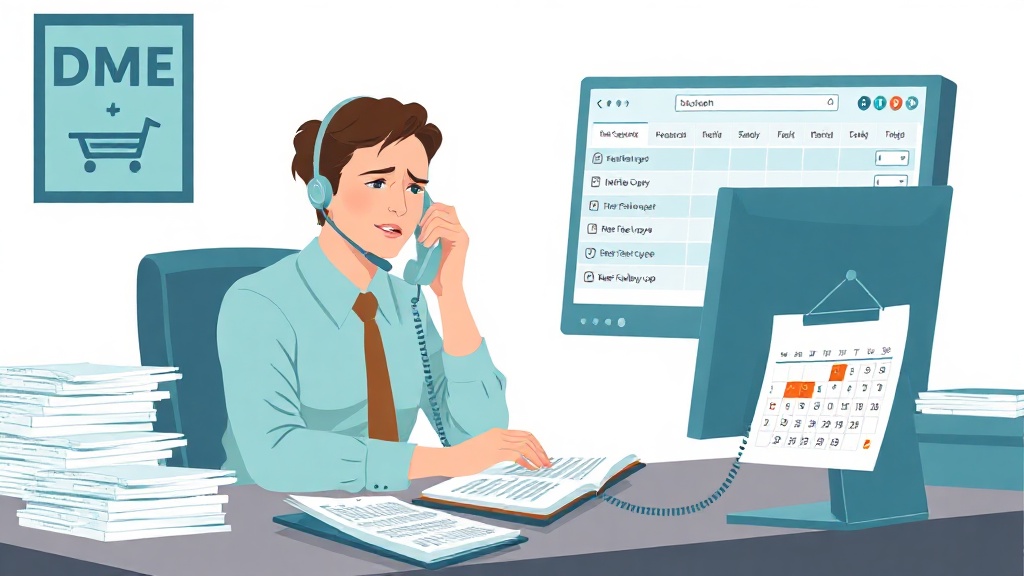
Ask any DME CSR what their least favorite task is and the answer is almost always the same: the reorder call list. Not because it's hard — it's actually simple. Pull up patient name, dial the number, leave a voicemail if there's no answer, try again tomorrow, move to the next one.
It's the task that never ends. 200 names on Monday. 200 new names on Tuesday. By Thursday the Monday list is still sitting there, because the patient didn't answer, and the CSR was handling intake, and then the afternoon verification queue backed up, and now it's Friday and those 200 names are still sitting there — and the patients who needed reorders in that batch have either called somewhere else or gone without supplies for another week.
This is the 6-hour problem. It's not a productivity issue. It's a structural issue — manual calling at DME reorder volume is fundamentally the wrong tool for the job, and every week operators discover this the hard way.
Where the 6 Hours Actually Go
When operators tell me they spend 6 hours a week on reorder calls, I ask them to break it down. The answer is always some version of this:
Let's run the math on a 200-patient reorder queue:
- 200 patients × 3 attempts = 600 call attempts at 5 minutes each = 50 hours of calling time
- Actual available CSR time for calling in a typical week: 6–8 hours
- Result: 60–70% of the queue never gets reached on any attempt
The 6 hours isn't wrong — it's the time budget the CSR can spend on reorder outreach. But it's 6 hours against a 50-hour problem. The gap doesn't close, so patients fall through. The ones who do get through — the 65% who answer on the first call — often reach a CSR who's also juggling 10 other tasks and doesn't have the full patient context at hand. The call quality suffers even when the call gets made.
The Voicemail Problem
Most patients don't answer their phones. Especially during business hours, when they're at work. The CSR leaves a voicemail — "Hi, this is [Name] calling from [Distributor] about your medical supply reorder" — and waits. The patient may call back. They may not. If they do call back, it goes into a queue, and by the time it's handled the reorder window may have passed.
Operators who run manual reorder programs report that 55–65% of their first outreach attempts go to voicemail. Of those voicemail recipients, 30–40% call back. That means 35–40% of the initial outreach list produces no response — and on a manual program, those patients often don't get a second outreach attempt before the window shifts.
The Context-Switching Tax
CSR work is multi-threaded by nature. The reorder call list runs alongside intake processing, verification calls, denial follow-up, and patient questions. Every time a CSR switches between tasks, there's a cognitive tax — they have to reload the context, remember where they left off, pick up the thread.
For a task like reorder outreach that has no urgency signal (no patient is calling in and saying "I'm waiting on a reorder"), it gets deprioritized automatically whenever something with an immediate deadline appears. The reorder call list shrinks when intake surges, expands when there's a quiet afternoon, and never actually gets through.
Why "Work the List Faster" Is the Wrong Solution
The instinct is to optimize the manual process: better scripts, dedicated calling blocks, priority queues, CRM tooling to track attempts. These changes help — but they're optimizing a system that can't be optimized to the level needed.
Manual calling has a hard ceiling. One CSR can make, at most, 60–80 quality call attempts in a 6-hour window — accounting for no-answers, hold music, transfers, documentation. That ceiling doesn't change with better scripts or better tools. The math is simple: 80 calls against a 200-patient queue means 60% of the list is untouched every week.
The operators who have actually solved this problem didn't work faster. They changed the channel.
What Automated Outreach Actually Looks Like
Automated reorder outreach isn't about replacing the CSR's judgment — it's about removing the CSR from every interaction that doesn't require judgment. The system handles the first two to three outreach attempts via SMS and automated voice, with one-click confirmation built in. The CSR's queue shows only the patients who need escalation: didn't respond to any outreach, have a documentation issue, or have a question the automated system can't answer.
This shifts the CSR's role from volume handler to exception handler — and that's the key difference. Instead of spending 6 hours calling 80 patients and making 20 orders, the CSR spends 2 hours handling 30 escalated patients and making 25 orders. The remaining 50 patients received automated outreach and confirmed their reorder via SMS without any CSR involvement.
The Time Audit: What Changes When Outreach Is Automated
Here's what the before/after looks like for a 200-patient monthly reorder queue:
The 4-hour reclaim isn't from working faster — it's from removing CSR involvement from the outreach step entirely. Automated SMS and voice go out simultaneously to all eligible patients. The patients who respond "YES" are confirmed. The patients who don't respond get a second automated touch. The CSR only enters the flow when escalation is needed.
The Confirmation Rate Difference
Manual calling achieves approximately 15–18% conversion from outreach attempt to confirmed reorder. The patient answers the phone, confirms interest, but then needs to call back to actually place the order — and the call-back rate on inbound confirmation calls runs around 60–65%.
Automated one-click confirmation ("Reply YES to confirm your [supply category] resupply") achieves 30–45% conversion directly in the outreach thread. No call-back loop, no re-engagement friction. The patient confirms in 10 seconds and the order enters the fulfillment queue.
The difference: 15% confirmed via manual outbound vs. 40% confirmed via automated one-click SMS. For a 200-patient queue, that's 30 confirmed orders vs. 80 confirmed orders.
What the CSR Actually Does in an Automated System
This is the part that surprises operators who haven't moved to automated outreach: the CSR role doesn't go away. It changes.
In a fully automated reorder system, the CSR is managing exceptions. Patients who didn't respond to any automated outreach. Patients whose documentation is incomplete and needs to be completed before the order can go through. Patients who have a billing question or want to change something in their order. Edge cases that require human judgment.
Patients who didn't respond to automated outreach surface in the CSR's exception queue — not the full 200-name list, but the 30–40 who need actual human phone time. The CSR calls once, with full context, and handles the exception in a single interaction.
Before an order goes to fulfillment, the system flags documentation gaps: expired CMN, prior auth needed, coverage verification pending. The CSR resolves the gap — often with a 5-minute payer call — and the order proceeds. No billing-side denial, no rework cycle.
Patients who text back with a question — "I need a different mask size" or "Is this covered by my plan?" — get a CSR response, not an automated generic reply. The CSR has the full patient context in the queue and handles the question in one interaction.
The net result: CSR time shifts from volume-dialing to high-value interactions that actually require a human. And the volume that was taking 6 hours per week now happens automatically, reaching 100% of eligible patients instead of 40%.
See the workflow: ScriptRelay's Auto-Reorder Engine shows the full automated outreach flow — eligibility scanning, multi-channel outreach, one-click confirmation, exception queue — in a live demo environment.
The 4-Hour Reclaim Is the Floor, Not the Ceiling
Most operators who implement automated reorder outreach start by tracking the CSR time reclaim — "we got back 4 hours per week." That's accurate, but it undersells the actual impact.
The CSR time reclaim is real and valuable. But the bigger win is the conversion rate improvement. 80 confirmed orders from a 200-patient queue vs. 15–18 from a manual program. That difference — 65 orders vs. 18 orders — is the actual number that shows up on the revenue side.
At $200 average CPAP resupply order value, the difference between a 90% automated and a manual program on a 200-patient queue is $9,400 per month in recovered revenue. Annualized: $112,800.
That's the actual value of the 4-hour reclaim. The 4 hours is what the CSR gets back. The $112,800 is what the operation gains by actually reaching the patients it was supposed to be reaching all along.
Calculate your reorder gap: Run your patient count and order value through the Reorder Leakage Calculator. It shows annual leakage from un-contacted patients — which is the same gap that automated outreach fills.
How to Actually Implement This Without Breaking What Already Works
Operators who've been running manual reorder programs for years are understandably cautious about changing the outreach process. Here's the implementation sequence that works:
Pick CPAP resupply if that's your highest volume. Run the automated outreach system in parallel with your existing manual process for 30 days. Compare conversion rates. The automated system will outperform the manual process — once you see the data, the transition becomes obvious.
Don't let CSRs go back into the outreach list manually. Automated outreach handles the initial reach; the CSR handles only the exception queue. This keeps the 6-hour-per-week problem from reasserting itself.
Once CPAP is running cleanly, add diabetic supplies, then lymphedema, then other categories. Each category has its own outreach timing and payer rules — the automated system handles the calibration; the CSR just manages exceptions.
The key constraint: don't try to automate everything simultaneously. The 30-day parallel run on one category gives you data, confidence, and a process the team actually understands. From there, the expansion is straightforward.
The Bottom Line
The 6 hours per week going to manual reorder calling isn't a CSR productivity problem. It's a system design problem. Manual calling at DME reorder volume is a square-peg/round-hole situation — the shape of the task doesn't match the tool being used.
Automated outreach doesn't replace the CSR's judgment. It removes the CSR from the tasks that don't require judgment — the initial outreach, the reminder, the one-click confirmation — so they can spend their time on the tasks that do: exception handling, documentation resolution, patient questions.
The 4-hour reclaim is real. But the $112,800 annual revenue recovery on a 200-patient operation is the actual business outcome. The time savings are a side effect of the process change — not the goal of it.
If your operation is still running manual reorder outreach, the math is telling you something. The question is whether you're listening to it.
Go deeper: The 23% reorder leakage guide covers the full four-step systematic fix — eligibility surfacing, automated outreach, one-click confirmation, and pre-submit documentation checks. Start there for the complete picture.
Reclaim the 6 Hours — and the Revenue Behind It
ScriptRelay's Auto-Reorder Engine handles outreach, confirmation, and exception escalation — so your CSR focuses on the 20% of cases that need human judgment.
See the Reorders Module → Calculate Your Leakage Or calc your full ops waste →